DSO Network Drops Patient Acquisition Cost by 38%

A private-equity-owned DSO mandated CAC reduction as a platform-thesis priority. The 26-location network had no marketing-to-chair attribution. They couldn't reduce what they couldn't see.
Business Challenges
The PE-firm board observer joined the DSO's quarterly operating review in early 2025 with a single agenda item. The platform thesis when the firm acquired Lakefront Dental Group two years prior had assumed a CAC reduction from $228 to $150 over five years. The thesis was a third complete on the timeline, and the CAC hadn't moved. The board observer wanted to know why.
The honest answer the COO, Lisa Yoo, had to give was that the network didn't know which channels were producing patients. The marketing team ran spend across 14 vendors — paid search, social, direct mail, community sponsorships, and two outsourced call-handling vendors. Each vendor reported its own metrics. None of the metrics tied back to actual chair-time revenue at the location level. The CFO's monthly close-cycle showed total marketing spend and total new-patient count, but the per-channel productivity was a black box.
The variability problem was worse. CAC at the highest-performing location ran $132. At the lowest, $312. Nobody could explain the gap. Some of it was channel mix (the lowest-CAC locations had relied more on community referral). Some were demographics. Some was likely operational — front-desk conversion of inbound calls to scheduled appointments varied by 40 points across locations. Without attribution, no remediation was possible.
- PE-firm thesis required CAC reduction from $228 to $150 over five years; two years in, CAC hadn't moved.
- Marketing spend ran across 14 vendors with no consolidated attribution back to chair-time revenue at the location level.
- CAC varied from $132 to $312 across the 26 locations, with no diagnostic ability to explain the gap.
- Insurance verification was re-run on 31% of new patients because cross-location patient sharing wasn't tracked.
- Recall and retention varied wildly across locations — some saw 24% recall response, others 8% — with no operational explanation.
Solution
Lisa's procurement was a co-evaluation with the network's CMO and the PE-firm operating partner. The framing was specifically about attribution — the platform had to close the loop from marketing spend to chair-time revenue at the location, channel, and individual-patient level. Anything less wouldn't move the platform thesis.
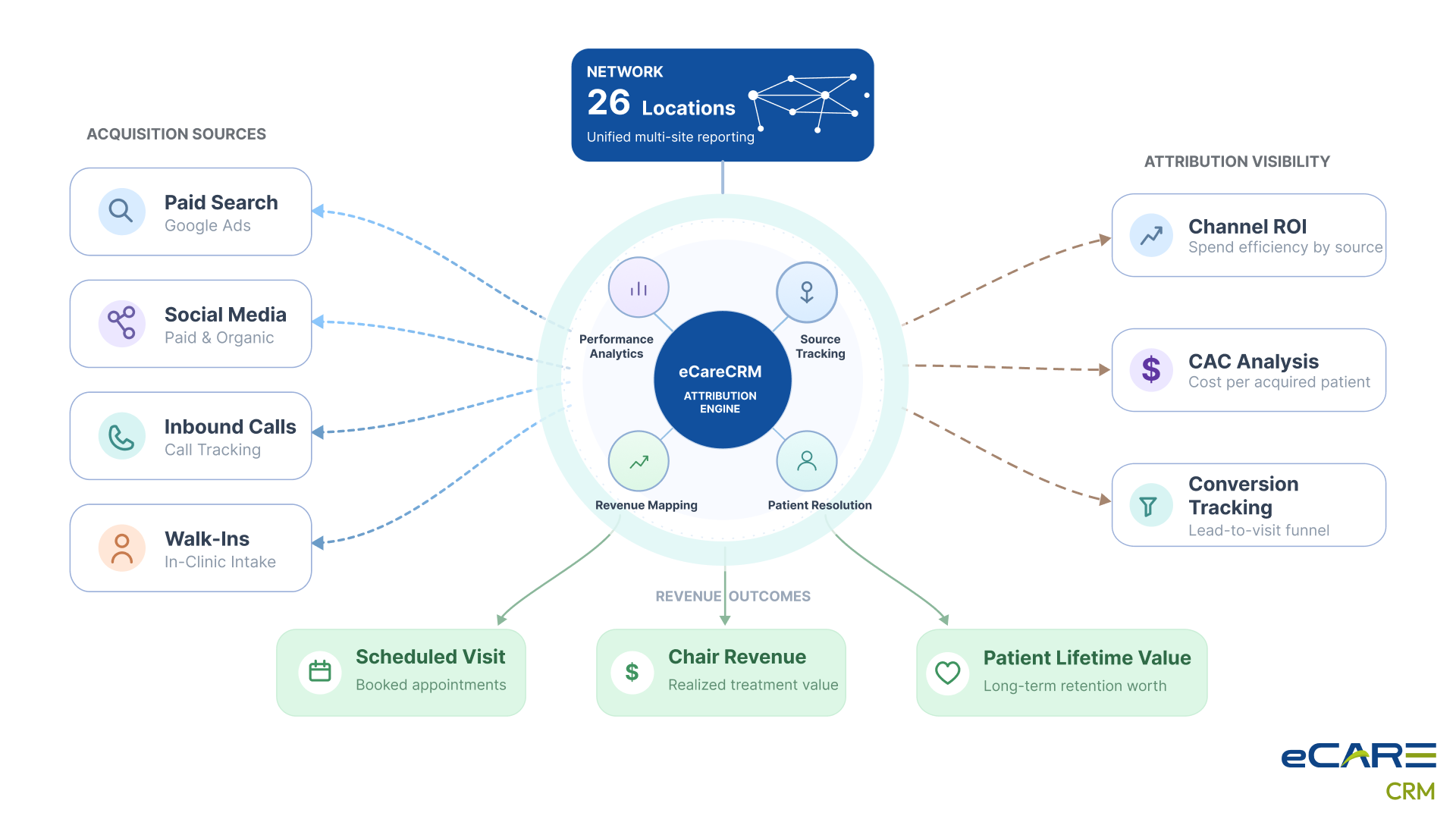
eCareCRM was selected after a technical due diligence session in which the eCareCRM team walked through the attribution model: every inbound patient signal (paid-search click, form fill, inbound call, walk-in) was tagged with channel source at creation, tracked through scheduling, tied to the first visit, and reported as revenue contribution. The CFO's team validated the model against a sample of Lakefront's actual patient acquisitions and confirmed the platform could reproduce the attribution Lakefront had been unable to produce internally.
The other capability that mattered was cross-location patient deduplication. Patients who saw a hygienist at one location and a dental implant specialist at another were being counted as two new patients with two separate insurance verifications. eCareCRM's patient-resolution layer surfaced the duplication and let the network see actual unique patient counts for the first time.
Value Delivered
Marketing-to-chair attribution went live network-wide by month four. The data immediately showed three things the marketing team hadn't seen before: paid social was generating 38% of leads, but only 8% of actual visits (leads weren't converting); community-referral channels were the highest-converting (62%) but were underfunded; and the two outsourced call vendors were performing 30 points apart in lead-to-appointment conversion.
- Network-wide CAC dropped from $228 to $141 within 10 months — exceeding the PE-firm five-year thesis 3 years ahead of schedule.
- 100% of marketing spend is now traceable to chair revenue at the location, channel, and patient level.
- New-patient visits grew 38% through optimized channel mix despite a $1.6M reduction in absolute marketing spend.
- Recall response standardized at 22% network-wide; lowest-performing locations lifted from 8% baseline.
- $1.6M annual marketing spend reduction with higher patient throughput — the operational economics flipped.
Solution Provided
The deployment took 16 weeks because of the network's scale — 26 locations, 14 vendor integrations, and the need to validate attribution data before the marketing team would change spend allocation. Lisa structured it as a measurement-first engagement.
Weeks 1–4: Attribution Plumbing
The first month was technical integration. eCareCRM connected to all 14 marketing vendor APIs, the practice's PMS at each location, and the network's accounting layer. The attribution tagging was instrumented at each entry point. By week 4, the network had its first end-to-end attribution view — albeit on incomplete historical data.
Weeks 5–8: Historical Validation
The CFO's team and the eCareCRM analytics team validated the attribution against six months of historical data. Several adjustments were made — the patient-resolution layer required tuning for two locations with high name-collision rates. By week 8, the historical attribution was clean enough for the marketing team to use as a baseline.
Weeks 9–12: Marketing Spend Reallocation
The marketing team began reallocating spend based on the attribution data. Paid social spend was reduced 60%. Community-referral programs were expanded. The two outsourced call vendors were put on a competitive performance review; the lower performer was replaced within the quarter. The reallocations happened in two waves to allow measurement of cohort impact.
Weeks 12–14: Front-Desk Conversion Workflow
The location-level variation in front-desk conversion turned out to be a workflow issue, not a marketing one. eCareCRM's lead-management workflow was deployed at the front desk level to standardize the inbound-call-to-appointment conversion process. The lowest-performing locations lifted 18 points within four weeks.
Weeks 14–16: Network-Wide Standardization
The final phase was standardizing the recall and retention workflows across locations. Each location had built its own recall practice; some were sophisticated, most weren't. The platform's recall automation was rolled out uniformly. The response-rate variation collapsed within a month.
Business Value
The PE firm's annual investor letter for 2025 named the Lakefront engagement as a portfolio highlight. The board observer who had pressed Lisa in the early-2025 review brought peer DSO operating partners to a Lakefront board meeting eight months later — an unusual moment of cross-portfolio learning that the firm hadn't done before.
What changed about Lakefront's operating model
Marketing at Lakefront is now a measured function rather than a budget allocation. Spend by channel by location is reviewed weekly. Underperforming spend is reallocated within the quarter. The marketing team is half the size it was at acquisition and produces 38% more new-patient throughput.
What the financial picture shows
The $1.6M annual marketing spend reduction plus the $1.9M incremental revenue from new-patient growth produced a combined annual financial impact of approximately $3.5M against a $480K platform cost. The PE-firm thesis is being delivered on a compressed timeline, and the firm has used the engagement as the basis for spending discipline at three other portfolio DSOs.
What changed about how the PE firm evaluates DSO investments
Marketing-attribution maturity is now part of the firm's DSO due diligence checklist. DSOs that don't have closed-loop attribution are scored as carrying operational risk. The firm has explicitly cited the Lakefront engagement in two subsequent acquisitions as the basis for first-year value-creation planning.
The line Lisa uses with peers
"We had been managing the marketing budget like it was an act of faith. The minute we could see what was actually working, the budget got smaller, and the results got bigger. The visibility was the entire story."